
Before you make a marketing hire, count to ten.
Marketing strategy. Brand. Content. Web design and development. Video. Social media. Advertising and media planning. Communications. Marketing operations. Automation.
Ten roles. One job posting.
When you decide to take marketing seriously, your first thought is to hire one person to do all of the above. Read the list again. You would never run any other department this way. Whatever your organization actually delivers, it is not the work of one person. Someone plans it, someone runs it, someone checks it before it reaches anyone. You staff it that way on purpose, because no one person can do it all. Yet in marketing, the one-person department is the one impossible job we all agree to pretend is possible. It’s not. Marketing needs what the rest of your organization already has. A team.
Ten roles run a marketing department.
Each one is a role of its own, with real work behind it.
The plan that decides where the money goes and reads where the market is heading before you commit it. Done well, it sets positioning, defines the audience, picks the channels, and gives every other job a target to hit. This is the marketing strategy and brand positioning work that keeps a budget from being spent on motion that does not move anything.
One brand identity, art-directed so it holds across a logo, a trade show booth, an annual report, and a social feed without falling apart. Done well, it pairs that identity system with real photography and design that earns belief instead of borrowing stock. This covers brand identity, visual identity, logo and design systems, and the art direction that keeps everything looking like one organization.
Ongoing content produced at volume that builds an audience and earns authority, plus the copywriting that makes one specific reader act. Done well, content marketing feeds your SEO, your social channels, and your email program from a single editorial engine instead of starting from zero each month. This is blog and article writing, copywriting, editorial strategy, and content production that gives the rest of the marketing function something worth distributing.
A site designed and built to convert and to be found, covering UX, accessibility, and the code underneath. Done well, the website is built for SEO and the AI answer engines, with AEO and GEO so it surfaces in search and in AI answers, and it meets accessibility standards like ADA and WCAG. This includes web design and development, landing pages, conversion rate optimization, and the technical work that lets shoppers and answer engines actually find you.
Video that changes what a viewer does next, scripted and shot to carry a story rather than fill a slot. Done well, video production spans brand films, testimonials, social cutdowns, and explainers sized for the channel they run on. This is the video production and motion work that gives social, advertising, and the website their highest-performing asset.
The networks that actually move the audience you want, run as a managed program instead of scattered posts. Done well, social media management pairs an organic content calendar with community management and the reporting that shows what each channel returns. This covers social media management, community management, organic social, and the channel strategy that decides where the organization should and should not show up.
The right message placed where your audience already is and tracked to what it returns. Done well, media planning and buying span PPC, paid social, programmatic, and retargeting, with budgets managed against cost per acquisition instead of impressions. This is the paid media, media buying, and campaign management that turns ad spend into measured results across search, social, and display.
High-stakes messaging and the authority of the people who deliver it, whether a CEO, a nonprofit director, or a leader speaking for a region. Done well, communications covers public relations, media relations, crisis communications, donor and stakeholder stewardship, and thought leadership. This is the PR and executive-voice work that makes a leader the recognized voice of their cause, company, or place.
The tracking, reporting, and clean handoffs that tell you what is working and decide which tools earn their seat. Done well, marketing operations covers analytics and attribution, CRM, marketing automation, and email marketing, wired together so data moves without manual rework. This is the martech, reporting, and operations layer that makes every other job measurable and repeatable.
AI applied where it genuinely earns its keep, with the judgment to know where it does not. Done well, automation speeds up content production, reporting, personalization, and routine workflow without putting the brand voice on autopilot. This is the AI and marketing automation work that adds capacity and speed while a person keeps decision rights over what ships.
Marketing strategy
The plan that decides where the money goes and reads where the market is heading before you commit it. Done well, it sets positioning, defines the audience, picks the channels, and gives every other job a target to hit. This is the marketing strategy and brand positioning work that keeps a budget from being spent on motion that does not move anything.
See how we cover all ten →This is what a great marketing function actually is: all of it, running at once, working together. Now picture building it yourself.
The salary is the part you can see.
An employee clocks in and clocks out. Our founder-led team owns the outcome.
Meet our founders.
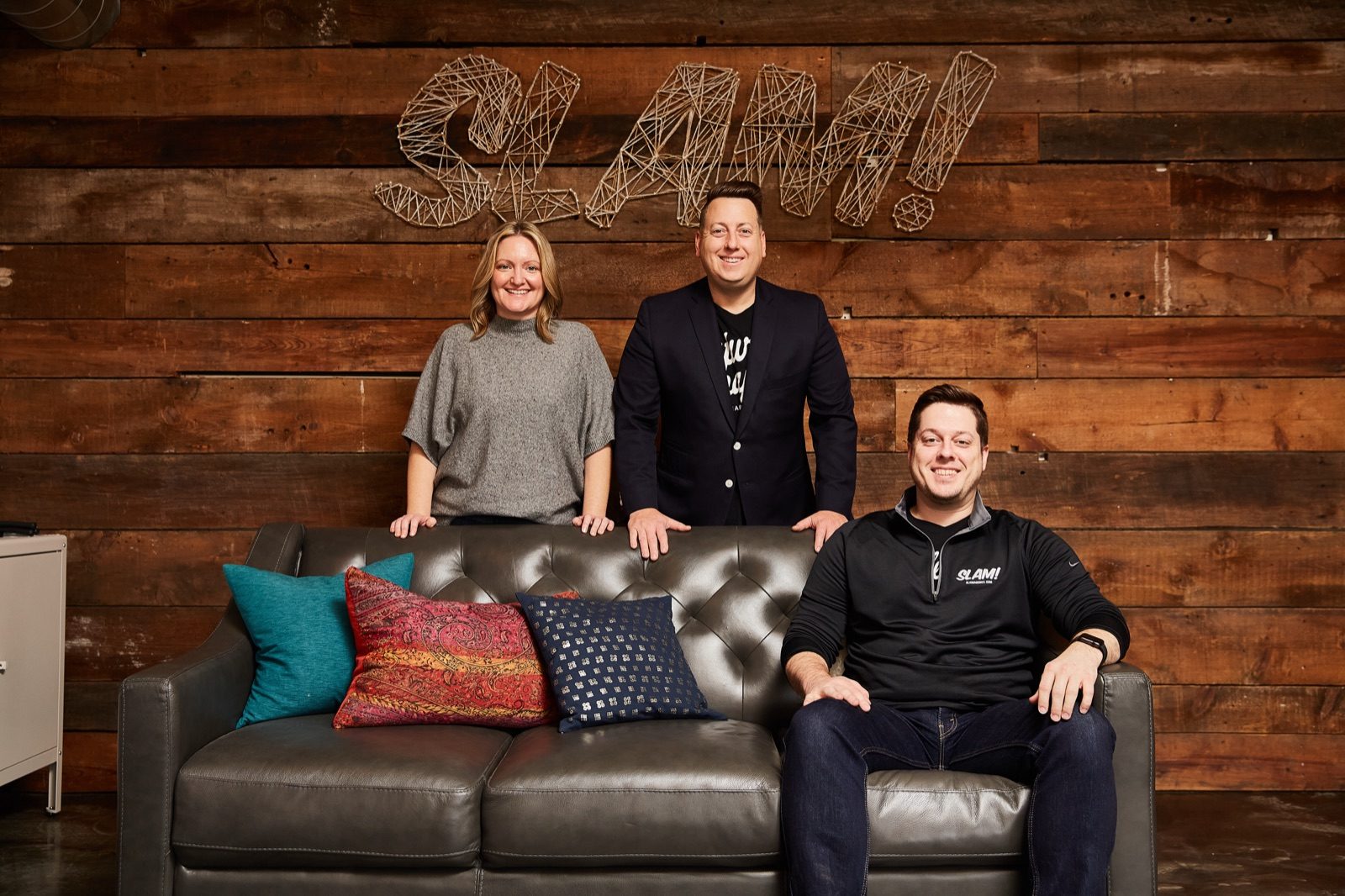
A traditional agency grows by taking on more accounts and hiring the junior staff to cover them. We do the opposite. A founding partner leads your account from the first day, never handed down, so we take on only as many as the three of us can lead ourselves. You work with that partner on where you are headed, and they put a full team behind the thinking to build it. It is senior attention aimed where it matters, with the bench to carry it out. Whether you run a company, a mission, or an institution, you get the same thing: a founding partner with their name on the result.
“SLAM goes beyond just being imaginative. They are effective.”
Tim Sanders, New York Times bestselling author